Starlight Foundation brings the case for night sky protection to Chile amid new challenges for astronomy
Antonia Varela, director of the Starlight Foundation, spoke at the Astronomy Policy Dialogue held in Santiago as part of CEDS 2026
2026 / 11 / 02
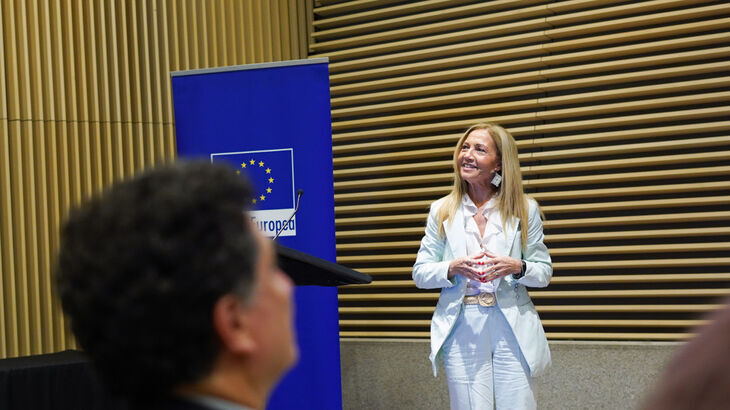
The protection of the night sky, light pollution and the need to adapt astronomy policies to the challenges of the new space age were at the heart of the Astronomy Policy Dialogue, held on 29 October in Santiago, Chile. Antonia Varela, director of the Starlight Foundation, took part in the event with a keynote talk on the value and preservation of dark skies.
The event brought together representatives of scientific institutions, public administrations and organisations connected to local communities to discuss the future of skies that constitute a natural and cultural heritage, as well as an essential resource for astronomical research.
The dialogue was led by the European Union Delegation to Chile, the European Southern Observatory (ESO) and Alberto Hurtado University, as part of the second edition of the International Conference on Space and Sustainable Development (CEDS 2026). It took place at the Faculty of Physical and Mathematical Sciences of the University of Chile and was attended by Chile’s Minister of Science, Technology, Knowledge and Innovation, Ximena Lincolao.
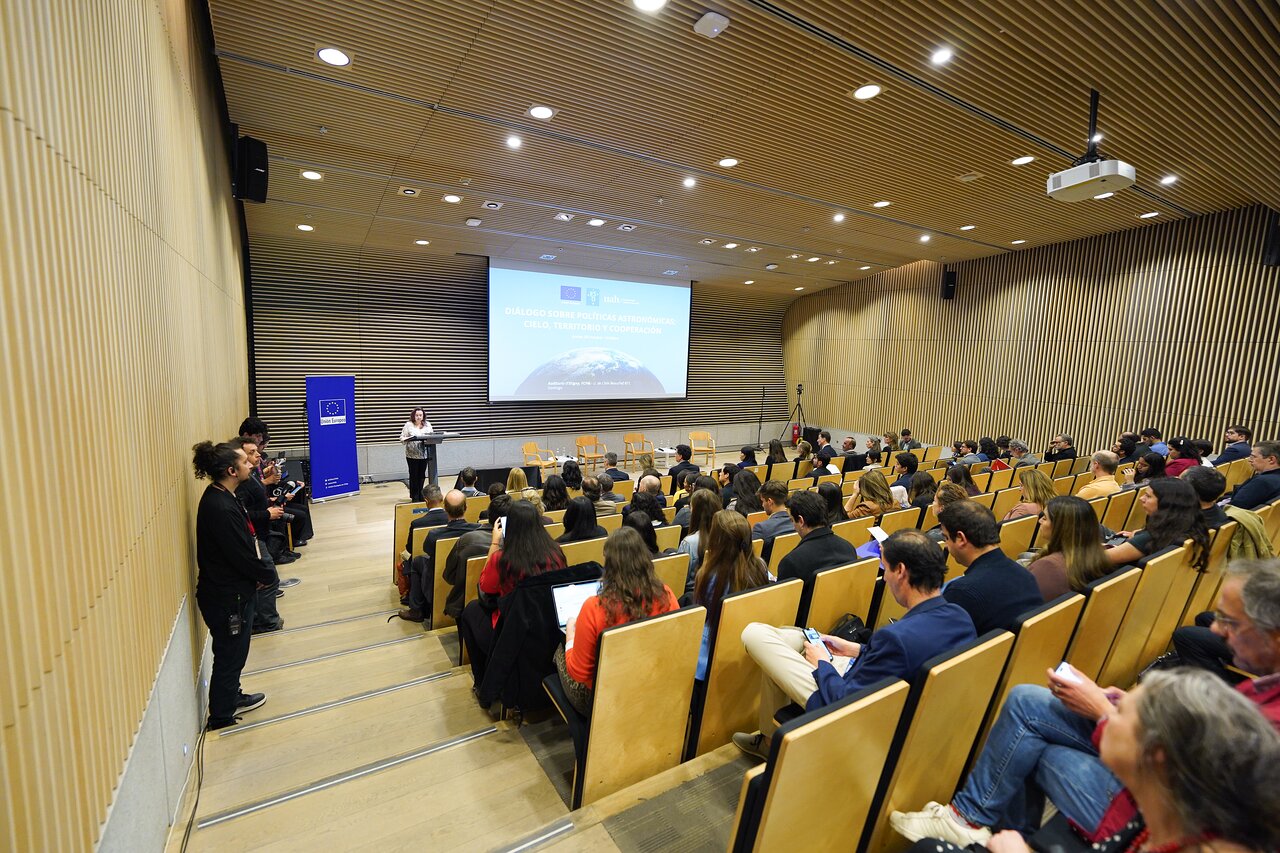 Itziar de Gregorio-Monsalvo, ESO representative in Chile, speaking at the opening of the Astronomy Policy Dialogue during the 2026 International Conference on Space and Sustainable Development (CEDS), held at the University of Chile / Credit: N. Schafer/ESO.
Protecting the sky requires planning and cooperation
Antonia Varela, director of the Starlight Foundation, and Daniela González, executive director of Fundación Cielos de Chile, each delivered a keynote talk on the scientific, environmental and cultural value of dark skies.
Their presentations addressed the need to tackle light pollution through regulation, spatial planning and appropriate lighting, as well as to strengthen sky quality monitoring and the implementation of existing protection measures.
These issues are particularly relevant to Chile, whose skies are home to some of the world’s leading astronomical observatories. Alongside the spread of artificial light, new challenges such as the proliferation of satellite constellations call for international cooperation and policies capable of responding to technological change.
The dialogue also explored the relationship between sky conservation, astrotourism and opportunities for local communities. Protecting natural darkness preserves the conditions needed for research while safeguarding a heritage connected to biodiversity, culture and the identity of local communities.
The defence of this heritage has been central to Antonia Varela’s work. Speaking previously in Madrid at the presentation of Albacete as an astrotourism destination, the director of the Starlight Foundation summed up that connection with a warning: “Without skies, there is no planet.” On that occasion, she linked the protection of the night to the responsible use of artificial light and lower energy consumption.
Science, regulation and local participation
One of the central issues discussed was the need to review regulatory frameworks in response to technological developments that had not been anticipated when many existing provisions were designed.
Participants also considered how to improve coordination between institutions and economic sectors, so that astronomical activity can coexist with other local initiatives and contribute to the development of communities near observatories.
The opening talks were followed by a technical panel featuring Gabriela López, director of the Office for the Protection of Sky Quality in Northern Chile; Itziar de Gregorio-Monsalvo, ESO representative in Chile; and astronomer Elise Servajean.
The programme also included an open workshop for participants from different sectors, where contributions were gathered on the future of astronomy policy in Chile. According to the organisers, these proposals will be brought together in a document of recommendations.
Chile and the Starlight Foundation: a shared journey under the stars
Antonia Varela’s participation in the dialogue forms part of a relationship between Chile and the Starlight Foundation that has developed over many years through night sky protection, training and the development of astrotourism.
The country has several territories within the Starlight Network. In the Antofagasta Region, the Alto Loa, Pampa Joya and Mano del Desierto Starlight Tourist Destinations have been recognised for the quality of their skies and their potential to bring astronomy closer to visitors.
Meanwhile, Bosque Fray Jorge National Park, in the Coquimbo Region, was designated a Starlight Reserve in 2013, becoming the first in South America. Other certified sites include the Starlight Village of San Andrés de Pica, in the Tarapacá Region; the Andacollo Pilgrim Route, certified as a Starlight Trail; and Reset Elqui Lodge, certified as Starlight Accommodation.
The Coquimbo Region is also home to three Starlight Tourist Observatories: Mamalluca, in Vicuña; Collowara, in Andacollo; and Cruz del Sur, in Combarbalá. These centres, included in the Starlight Star Parks category, combine observation of the universe with science outreach and a commitment to conserving the night sky.
Alongside these certifications, institutions have developed joint initiatives. The Starlight Foundation and Fundación Cielos de Chile, whose executive director also spoke at the Santiago event, have a cooperation agreement to promote sky protection, training and projects related to astrotourism.
When presenting the partnership, Antonia Varela highlighted Fundación Cielos de Chile’s work to raise awareness of sky preservation and communicate astronomy to the public. She noted that the collaboration would make it possible to “create synergies and promote joint projects”.
Training initiatives have also been developed in the country, including the Starlight Astronomical Monitors course in Coquimbo, which helps strengthen the skills of professionals working in astrotourism.
 Collowara Observatory, Chile.
Sky protection in the Chilean media
Antonia Varela’s visit to Santiago also attracted media attention. In the days leading up to the dialogue, the director of the Starlight Foundation spoke with journalist Andrea Obaid on “Tu Nuevo ADN”, a programme on Chilean radio station ADN, in an interview focused on sky protection.
The Starlight Foundation’s participation in this international event reinforces the importance of maintaining opportunities for collaboration among scientific institutions, public administrations, organisations and communities, so that the defence of the night sky forms part of decisions about the future of their territories.